society
FAULTLINES IN THE REGIONS OF KASHMIR & JAMMU
By Bashir Assad | Wed Feb 25 2026
The princely state of Jammu and Kashmir in 1947 stood at a uniquely precarious intersection of empire, geography and communal churn. Unlike many princely states that moved swiftly to accede to one or the other dominion, Jammu and Kashmir hesitated, oscillating between competing pressures from its demographically Muslim-majority valley, a politically assertive Hindu majority Jammu and the looming strategic calculations of both India and Pakistan.
That hesitation proved tumultuous.
In late October 1947, Pakistani tribesmen, an incursion supported by Pakistan’s establishment invaded Kashmir. Their rapid advance toward Srinagar shattered the already fragile equilibrium within the princely state, producing chaos, fear and administrative collapse. Maharaja Hari Singh, struggling to retain authority, fled Srinagar for Jammu, leaving behind a power vacuum at a moment of existential crisis.
Yet the turmoil in the valley was only one dimension of the catastrophe unfolding across the state. Simultaneously, Jammu witnessed violence of immense proportions. The Maharaja’s forces, aided by extremist militias, carried out widespread killings and expulsions of Muslims across the province. Fuelled by a volatile mixture of political insecurity and communal vengeance, the violence is estimated to have claimed around two hundred thousand Muslim lives, one of the lesser acknowledged tragedies of the subcontinent’s partition. These parallel traumas, one unfolding through invasion, the other through massacre, defined Jammu and Kashmir’s violent passage into the post-colonial order.
It was in these extraordinary and highly pressured circumstances that the Maharaja signed the Instrument of Accession on 26 October 1947. While the accession was legally executed and duly accepted by the Indian dominion, it arose from an urgent security emergency rather than a deliberated, broad-based political process. Embedded within it were anxieties that would shape the state’s post-colonial journey of fears of demographic imbalance, memories of communal violence and unresolved questions of political legitimacy across regions.
The post-colonial state that emerged was, in many ways, a mosaic of sharp contrasts. Kashmir possessed a distinct linguistic and cultural identity; Jammu was ethnically varied and religiously heterogeneous; Ladakh was home to Buddhist and Shia Muslim communities culturally linked to Central Asian and Tibetan worlds. Despite these differences, the country integrated them into a single political entity at a moment when democratic governance itself was still experimental.
This integration was both pragmatic and aspirational. Pragmatic because geopolitical realities demanded administrative coherence and Aspirational because the new republic envisioned pluralism as a foundational principle. In this sense, Jammu and Kashmir came to resemble a mini-India, a microcosm of the diversity and contradictions that defined the nation itself.
Yet the postcolonial compact rested on a fragile foundation. Each region carried grievances that long predated 1947 and the new political architecture did little to resolve them fully. Kashmir often perceived political processes as extensions of external control; Jammu harboured sentiments of neglect and alleged domination by Kashmiri elites; Ladakh experienced administrative remoteness and cultural marginalisation. These tensions rarely erupted simultaneously but they constantly shaped regional political imaginations beneath the surface.
The eruption of armed insurgency in 1990 deepened these fissures dramatically. While the valley descended into a prolonged militarised conflict, resentment in Jammu grew over the instability emanating from Kashmir and the perceived disproportionate influence of valley-centric politics on state governance. Ladakh, meanwhile, intensified its demands for autonomy, a trajectory that culminated decades later in its separation as a Union Territory.
The insurgency thus transformed not only Kashmir’s relationship with New Delhi but also the internal relationships among the state’s regions, hardening identities and deepening mutual incomprehension.
Another major rupture came with the 2008 Amarnath land row. What began as an administrative decision regarding land allocation to the Amarnath Shrine Board spiraled into a mass uprising in Kashmir and a powerful counter-mobilisation in Jammu. Economic blockades, counter-blockades, street protests and communal tensions followed, producing one of the most intense inter-regional stand-offs since 1947.
The episode revealed that the post-colonial architecture had not merely failed to resolve historical grievances; in some ways, it had amplified them through decades of accumulated mistrust.
Today, these unresolved tensions inform a new set of political alignments. Sections of Jammu’s leadership argue that their region’s aspirations cannot be fulfilled within a framework tethered to Kashmir’s unresolved conflict. Calls for a separate Jammu state have resurfaced, drawing upon narratives of discrimination, neglect and demographic anxiety. At the same time, though less coherently articulated, some voices in Kashmir have begun expressing the view that Jammu should be free to pursue its own political course if it believes Kashmir is holding it back. This marks a significant departure from earlier valley centric visions of unity.
The most contentious terrain in this evolving landscape lies in the ethnically and religiously mixed belts of the Chenab valley and the Pir Panjal region, particularly Poonch and Rajouri. Both Kashmir and Jammu seek to incorporate these areas into their respective political futures. Jammu’s argument rests on administrative logic, emphasizing existing divisional boundaries. Kashmiri perspectives draw upon historical and political imagination, partly rooted in Sir Owen Dixon’s proposals, which envisaged these regions as organically linked to Kashmir’s political identity.
The danger here lies not merely in constitutional rearrangements but in the social tensions such claims can ignite.
History repeatedly demonstrates that once the seeds of discord are sown, they rarely remain contained. The Chenab and Pir Panjal regions already marked by histories of communal violence, demographic shifts and political vulnerability could become flashpoints if regional polarisation continues to deepen. The massacres of 1947 in Jammu and the tensions of the 1990s in Chenab valley remain living memories. Reopening disputes over territorial belonging risks tearing at scars that have never fully healed.
Understanding the transition of 1947, therefore, is not merely an academic exercise. It is a necessary confrontation with the origins of political fragmentation that continues to haunt the region. The invasion, the massacre, the flight of the Maharaja and the accession together formed the crucible from which modern Jammu and Kashmir emerged.
The postcolonial political construct sought to overlay these contradictions with democratic institutions, special constitutional arrangements and rhetoric of unity. But without addressing foundational mistrust between regions, between communities and between the state and its people, the arrangement remained perpetually vulnerable to fracture.
The challenge before Jammu and Kashmir today is not simply to negotiate administrative futures but to confront the layered histories that produced its contemporary anxieties. Any future political architecture that ignores the memories of 1947, the fault lines of the postcolonial compact and the intensifying regional polarisation risks repeating the cycles of rupture that have defined the region for nearly eight decades.
If Jammu and Kashmir is to move towards stability, however that stability is defined as it must first grapple honestly with the contradictions at its birth and the trajectories they set in motion.
"Related Articles
HAIR BY HAIR: HOW A HOME WAS UNDONE
Bashir Assad
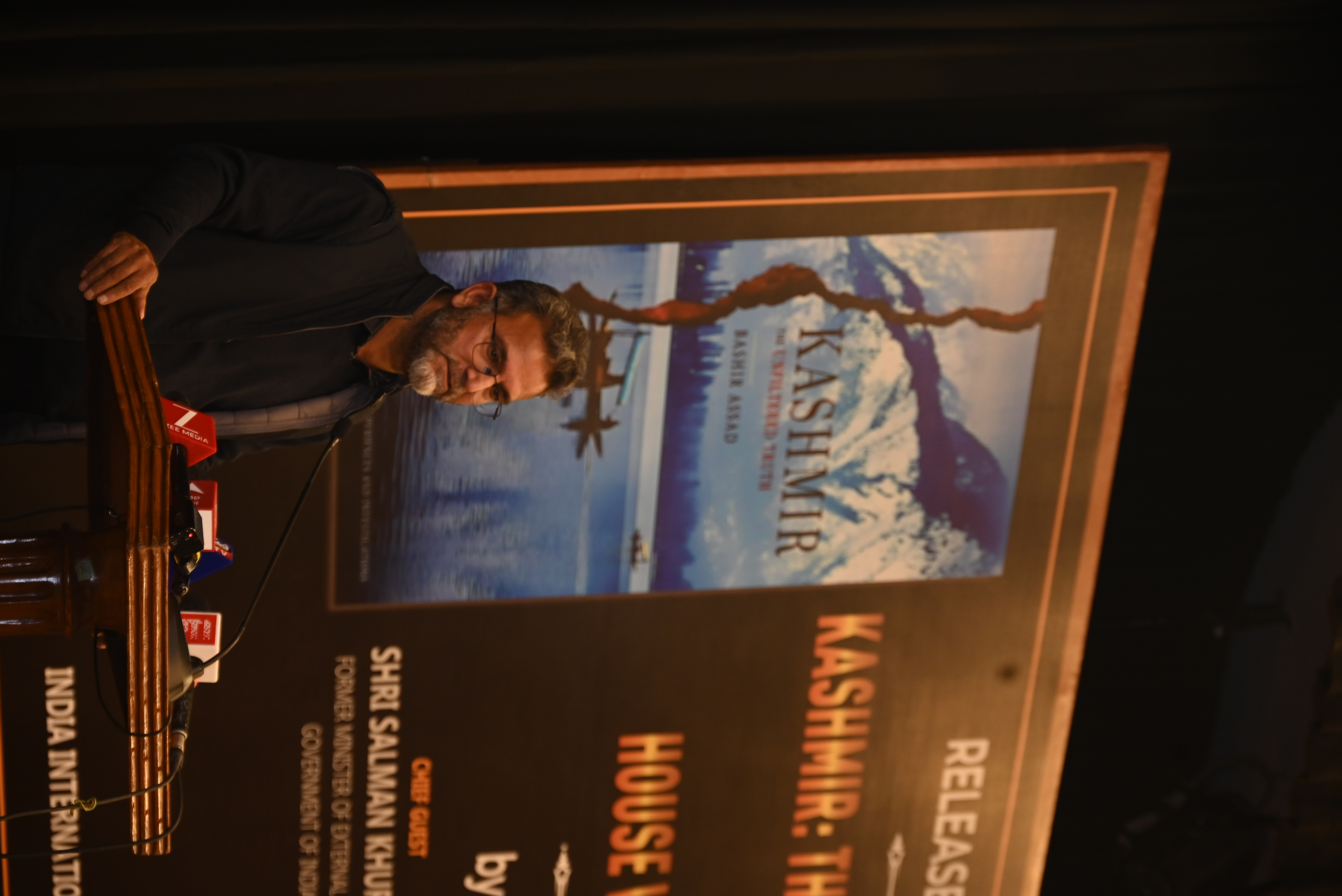
At the launch of the book, Kashmir: The Unfiltered Truth, the author chose allegory over accusation. Drawing from an old Kashmiri fairytale, this speech of the author reflects on possession, rivalry and exhaustion, offering a haunting meditation on how identities are lost to guardians who refuse to act together
THE CONSTITUTION AS CONTINUUM
Mian Tufail
The debate over Article 370 has been dominated by legal arguments and political slogans. This article examines constitutional history, local politics and the exhaustion of conflict in Kashmir; it explains why the manner of constitutional change matters as much as the change itself and what the future depends on.
KASHMIR: THE UNFILTERED TRUTH
Waseem Hassan
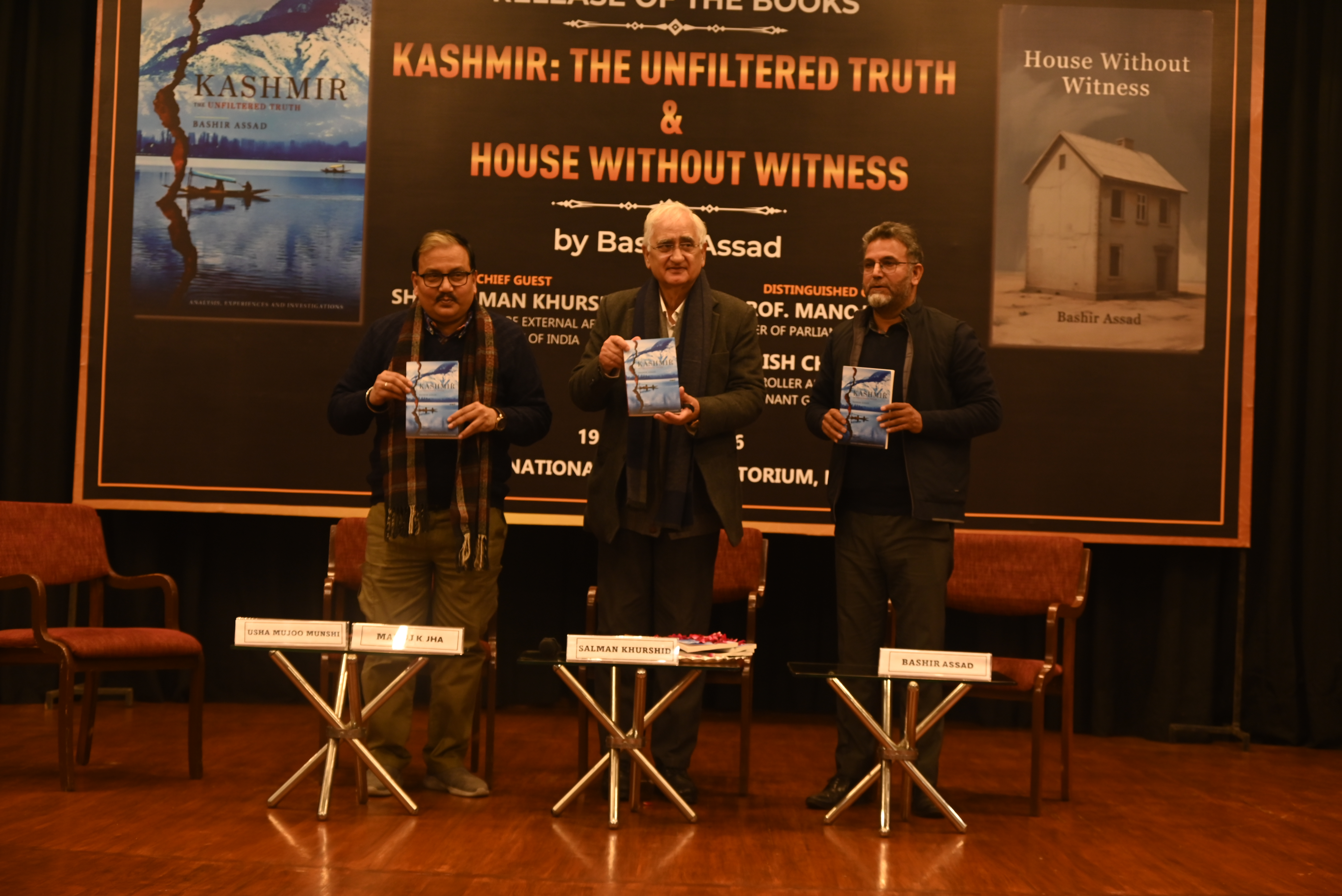
The launch of Kashmir: The Unfiltered Truth at the India International Centre became more than a book release, as it was a quiet assertion that Kashmir’s future lies in patience, participation and institutional trust rather than ideological triumph.
“THE MOTHER OF ALL DEALS” DECODING EU-INDIA FREE TRADE AGREEMENT
Dr. Mareaya Fayaz
Concluded after nearly two decades of uneven negotiations, the agreement reflects the European Union’s pursuit of open strategic autonomy and India’s calibrated move from defensive protectionism towards global integration. KC analyses how the EU–India FTA strengthens India’s strategic positioning.
As the tide shifts…
Dr. Mareaya Fayaz
JAMMU & KASHMIR. Here, a complex tapestry of political, social, and historical threads, weaves the narrative of a place long marred by conflict. The recent years, however, have witnessed a subtle but significant transformation in the security environment, offering a glimmer of hope for peace, progress and a renewed sense of ambition in the valley.
SNOWLESS WINTERS, SCORCHED ORCHARDS
Mian Tufail
In Kashmir, winter has always been more than a season. It is the valley’s silent architect, shaping rivers, nourishing springs and preparing orchards for the bloom of spring. Snow resting on the Pir Panjal and the higher Himalayas has traditionally functioned as a natural reservoir, melting slowly to sustain agriculture and drinking water systems through summer.