politics
“THE MOTHER OF ALL DEALS” DECODING EU-INDIA FREE TRADE AGREEMENT
By Dr. Mareaya Fayaz | Wed Feb 25 2026
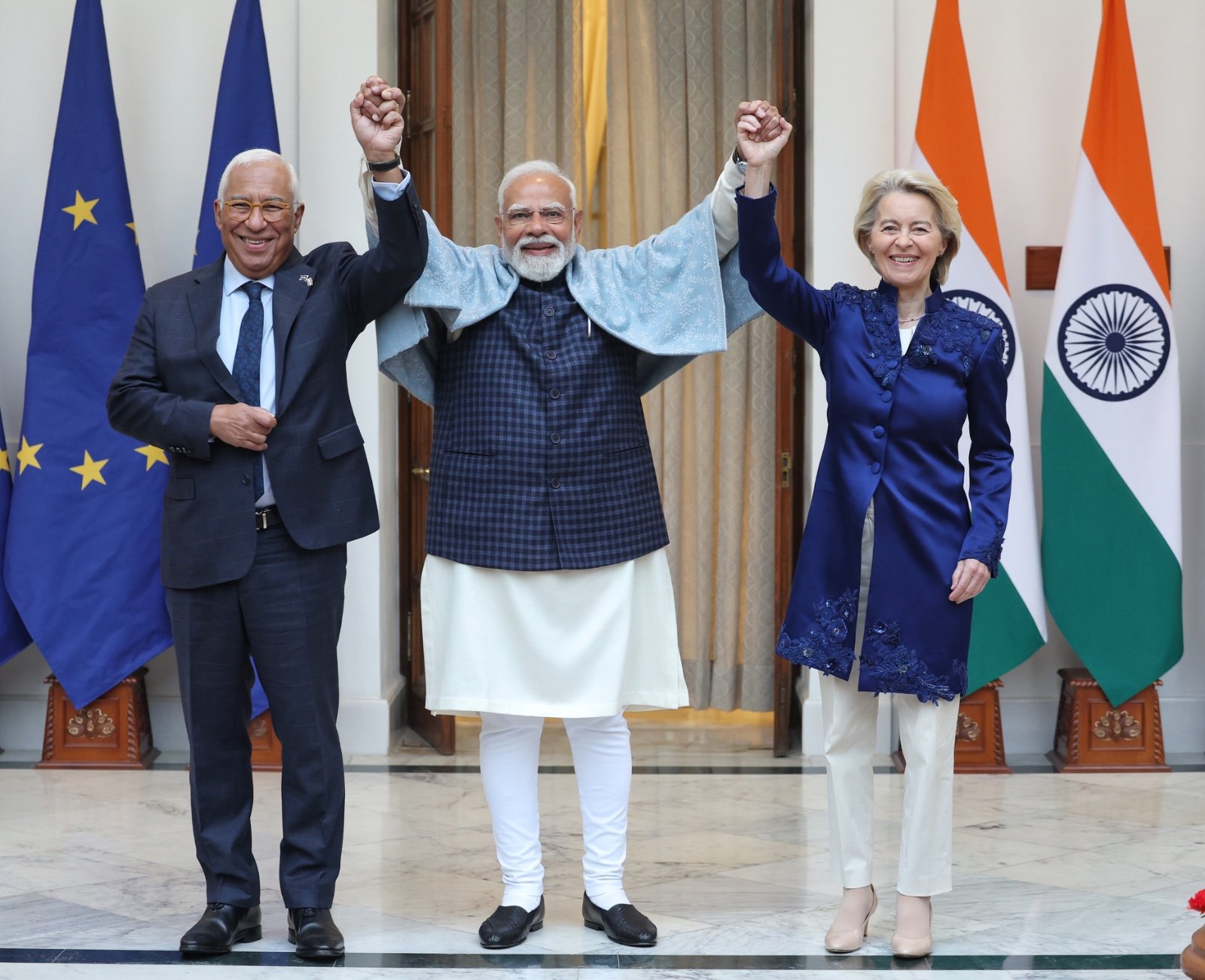
The Free Trade Agreement signed between the European Union and India marks the end of a long and uneven negotiation process that began in 2007, halted in 2013 and was re-established in 2022. The relaunch represents a broader rethinking of EU trade policy in response to global supply chain fragility, geopolitical rivalry and the need to broaden economic partnerships beyond traditional transatlantic and East Asian foundations. For India, the pact represents a selective shift away from its historically protectionist trade posture and toward a more balanced inclusion into global markets.
The long-awaited India-EU free trade agreement has finally been signed and the timing couldn't be more significant. Across Asia, economies have actively sought to expand export markets beyond the United States, a strategic decision that contributed to the region's strong export growth last year. The India-EU agreement supports this momentum.
Some have dubbed it the “mother of all deals” as it could mark the start of a larger realignment in global commerce. The accord also demonstrates the EU’s willingness to take a measured, pragmatic approach to resolving India’s concerns about opening specific sectors, which contrasts with the US’s considerably less flexible position.
Ursula von der Leyen’s political framing of the agreement emphasizes its twin economic and normative ambition: the FTA is more than just a market-access mechanism; it is also a strategic cooperation between rules-based democracies. This discourse places the deal within the EU’s broader concept of open strategic autonomy, which prioritizes economic liberalization alongside resilience, regulatory sovereignty and value projection.
Preferential Treatment
India’s headline gain is the scale of market access. Preferential treatment across 97% of EU tariff lines, accounting for 99.5% of trade value, essentially ensures near-complete admission into one of the world’s largest consumer markets. Crucially, a major portion of this access is obtained by rapid duty removal rather than lengthy transition periods. That is especially important for labour intensive sectors like textiles, apparel, leather and footwear, which together account for about 2% of India’s GDP in exports and employ millions of people. In practice, the agreement boosts India’s competitiveness precisely where it is most vulnerable to margin and price competition.
This is strategically essential since it complements, rather than replaces, India's current trade agreements. India continues to be a net exporter of products and services to the United States and bilateral commerce with Washington is expanding. Merchandise trade was over USD137 billion in FY 2024-25, demonstrating that the United States remains a significant demand anchor. However, the EU agreement decreases India’s vulnerability to policy uncertainty in any single market, especially at a time when trade frictions and tariff threats are a common element of US politics after the taking over of Donald Trump.
The service dimension adds to this diversification tale. The trade in services between India and the EU is expected to reach USD 83 billion, showing substantial integration in IT, business and professional services. While the FTA’s immediate benefits are more obvious in the commodities sector, the pact establishes a more secure institutional framework for services trade over timean area where India’s comparative advantage may be even stronger.
Taken collectively, the agreement shifts India’s export strategy toward resilience rather than maximization. It may not result in a huge short-term export increase but it does significantly improve predictability, competitiveness and bargaining strength. In an era of fragmented trade and selective protectionism, that trade-off appears to be more strategic than cautionary.
The FTA demonstrates a deep but asymmetric liberalisation paradigm, taking into account structural disparities between a mature regulatory bloc and a fast expanding economy. India’s historic tariff concessions which cover more than 96% of EU goods exports represent a conceptual shift in Indian trade policy, where tariff protection has traditionally acted as an industrial policy weapon. The gradual lowering in tariffs on vehicles, machinery, chemicals and pharmaceuticals demonstrates a balance between liberalisation and domestic capacity growth.
For the EU, the pact follows its long-standing ideology of comprehensive free trade agreements, which include products, services, intellectual property and regulatory cooperation into a single legal framework. The predicted €4 billion yearly savings in customs and the expected doubling of EU exports by 2032 are not incidental effects but rather key grounds under EU trade law, which requires demonstrated economic benefit to Member States and employment.
A major doctrinal innovation is the explicit inclusion of Small and Medium-sized Enterprises in the agreement’s legal structure. Rather than considering SMEs as secondary benefactors, the FTA includes specialised institutional mechanisms contact points, transparency obligations and information sharing that signal a shift toward more inclusive trade governance. This is consistent with EU internal market theory, which emphasises legal certainty, predictability and administrative accessibility as essential characteristics.
Reduction of barriers
From a legal standpoint, these measures reduce non-tariff barriers, which have increasingly overtaken tariffs as the principal impediment to trade. The emphasis on regulatory stability and procedural clarity reflects the EU’s export of administrative law values into international trade relations.
The chapters on services and intellectual property demonstrate the EU’s theory of regulatory convergence through trade. India’s financial services obligations exceed those of any preceding partner, demonstrating trust in EU regulatory frameworks and supervisory standards. In terms of intellectual property, the agreement goes beyond WTO TRIPS duties by enhancing enforcement and matching legal ideas for trademarks, designs, trade secrets and plant variety rights.
Doctrinally, this underlines the EU’s view of intellectual property as a prerequisite for innovation driven growth and cross border investment, rather than simply a commercial asset. Legal approximation in intellectual property law lowers transaction costs while increasing legal security for both sides.
The inclusion of a strong trade and sustainable development chapter fits the agreement squarely within the EU’s ideology of values-based trade. Environmental protection, labour rights, gender equality and climate action are legally binding obligations supported by conversation and cooperation structures.
The proposed EU-India climate cooperation platform, as well as the €500 million in EU financing, demonstrate the growing convergence of trade, development finance and climate governance. This indicates a growing doctrinal consensus within EU law that trade agreements are valid vehicles for furthering global public goods, as long as they respect proportionality and partner country capacities.
The ratification process emphasises the EU’s complex constitutional system. After legal cleansing and translation, the agreement must be authorised by the Council, agreed upon by the European Parliament and formally concluded by the Council before it can go into effect, subject to India’s ratification. This multi-level procedure embodies the EU’s theory of democratic legitimacy in foreign action, which ensures legislative supervision of major economic commitments.
The EU-India Free Trade Agreement is a strategic use of trade as a geoeconomic tool, rather than a solely commercial agreement. The deal, reached amid rising great power rivalry, supply chain fragmentation and contentious global governance, enables both the European Union and India to lessen their vulnerability to economic coercion by deepening dependency with a like-minded partner. By establishing a preferential economic zone containing nearly two billion people, the pact strengthens each side’s strategic autonomy while maintaining openness.
From the EU’s geo economic standpoint, the FTA supports its ideology of open strategic autonomy by diversifying markets away from over-reliance on China and strengthening resilient supply chains in manufacturing, medicines, agri-food and services. The extent of India’s tariff concessions, which are unique in its trade policy, provides EU enterprises with first-mover advantages in the world’s fastest growing major economy, converting regulatory and market access into long-term structural impact. Trade liberalisation thus serves as a vehicle for power projection, integrating EU standards and regulations into India's economic ecology.
For India, the deal signals a shift in geoeconomic strategy from defensive protectionism to selective integration. By offering asymmetric market access while maintaining safeguards for sensitive sectors, India uses the FTA to attract investment, develop industrial capacity and strengthen its position in non-Chinese global value chains. Improved access to EU service markets and greater intellectual property protections demonstrate India’s desire to advance up the value chain rather than remain a low-cost manufacturing hub.
Overall, the EU-India FTA illustrates modern geo economics that commerce is used to provide strategic resilience, influence regulatory trajectories and stabilize alliances in an increasingly fragmented global economy. Rather than signaling de-globalization, the deal represents a change toward selective, alliance based globalization based on trust, regulations and long-term strategic alignment.
Critical analysis
The EU-India Free Trade Agreement should be viewed primarily as a tool of geo economic statecraft rather than a traditional trade liberalisation exercise. The pact operationalises the European Union’s policy shift toward leveraging market access, regulation and investment as means to maintain geopolitical influence in a more fragmented global order. Trade is used not just to achieve economic gains but also to organise dependencies, anchor alliances and decrease vulnerability to systemic rivals, representing the EU’s transition from trade multilateralism to selective strategic bilateralism.
Geoeconomically, the FTA serves as a de-risking tool for China without explicitly decoupling. By strengthening economic ties with India, the EU diversifies supply chains in pharmaceuticals, machinery, automotive components and services, lowering its vulnerability to economic coercion. This is consistent with a broader geopolitical goal of developing alternative production hubs in the Indo-Pacific. However, the pact runs the risk of using India as a strategic counterweight rather than recognising it as an equal normative partner, potentially leading to expectations and long-term trust gaps.
From India’s standpoint, the deal represents a deliberate geopolitical hedging tactic. While India strengthens economic connections with the EU, it avoids exclusive alignment by preserving policy space in sensitive sectors and maintaining a diverse interaction with other global powers. The FTA enables India to seek capital, technology and regulatory credibility from Europe while maintaining its strategic autonomy rather than subordinating it. Nonetheless, the magnitude of the concessions gained raises concerns about whether economic openness may, over time, limit India’s ability to pursue independent industrial and strategic strategies.
A key geoeconomic characteristic of the deal is the EU’s export of regulatory standards. The EU incorporates its regulatory standards into India’s economic governance structure via rules on intellectual property, services, sustainability and food safety. This exercise of regulatory power converts legal harmonisation into geopolitical influence, since adhering to EU norms becomes a prerequisite for entering a profitable market. While effective, this strategy may spark domestic political opposition in India, especially if regulatory conformity is viewed as an external restraint rather than mutual convergence.
The agreement’s sustainability and climate components demonstrate the intersection between geopolitics and economics. By tying economic access to climate cooperation, financing, and normative obligations, the EU positions itself as a key player in India’s green transformation. This moves climate policy from a technical realm to a strategic bargaining tool. However, the mismatch in financial and technological capabilities raises worries that sustainability promises may serve as tools of persuasion rather than true co-constructed goals.
Geopolitically, the EU-India FTA adds to the rise of alliance-based globalisation, in which economic flows are increasingly guided by strategic alignments rather than universal rules. While this increases resilience among like-minded partners, it also speeds up the fragmentation of the global economic system. Thus, the deal represents a contradiction: it strengthens bilateral rules based cooperation while eroding the universality of global trade regulation.
Economic interconnectedness while theoretically stabilising has the potential to develop future leverage asymmetries. If political relations deteriorate, trade ties may be weaponised. Furthermore, diverging geopolitical trajectories particularly India’s non-aligned foreign policy legacy and the EU’s normative conditionality may undermine the alliance in the long run. The FTA’s success will thus be determined by whether geoeconomic cooperation can continue independent of geopolitical divergence.
In geoeconomic and geopolitical terms, the EU-India trade agreement is a strategic alignment of convenience rather than a completely formed alliance. It represents a reality in which trade agreements are no longer neutral economic instruments but rather critical tools for power, influence and risk management. The agreement’s long-term viability will be determined by its ability to strike a balance between economic integration and political autonomy, as well as strategic cooperation and normative constraints. And for the moment it can be truly called as the “mother of all deals.”
"Related Articles

HAIR BY HAIR: HOW A HOME WAS UNDONE
Bashir Assad
At the launch of the book, Kashmir: The Unfiltered Truth, the author chose allegory over accusation. Drawing from an old Kashmiri fairytale, this speech of the author reflects on possession, rivalry and exhaustion, offering a haunting meditation on how identities are lost to guardians who refuse to act together
THE CONSTITUTION AS CONTINUUM
Mian Tufail
The debate over Article 370 has been dominated by legal arguments and political slogans. This article examines constitutional history, local politics and the exhaustion of conflict in Kashmir; it explains why the manner of constitutional change matters as much as the change itself and what the future depends on.

KASHMIR: THE UNFILTERED TRUTH
Waseem Hassan
The launch of Kashmir: The Unfiltered Truth at the India International Centre became more than a book release, as it was a quiet assertion that Kashmir’s future lies in patience, participation and institutional trust rather than ideological triumph.
FAULTLINES IN THE REGIONS OF KASHMIR & JAMMU
Bashir Assad
Jammu and Kashmir’s present anxieties cannot be understood without confronting its violent birth. By revisiting invasion, communal violence and the unresolved regional compact of 1947, KC argues that today’s political realignments are the aftershocks of an unfinished postcolonial settlement.
The Protest That Won’t Go Away
Rafi Ahmad Mir
Pakistan-administered Kashmir and the limits of political management

WHO OWNS KASHMIR’S WATER?
Sohail Bhat
The rivers of Kashmir have always been more than scenery. They have carried people, shaped settlements, fed fields, powered machines and remained at the centre of one of South Asia’s enduring conflicts. As the old arrangements around water enter uncertain territory, a more immediate question is emerging inside Kashmir itself: who benefits from the water that flows through it?