politics
Jamaat’s Old Problem: The Politics of Compromise and Denial
By Bashir Assad | Wed Oct 07 2026
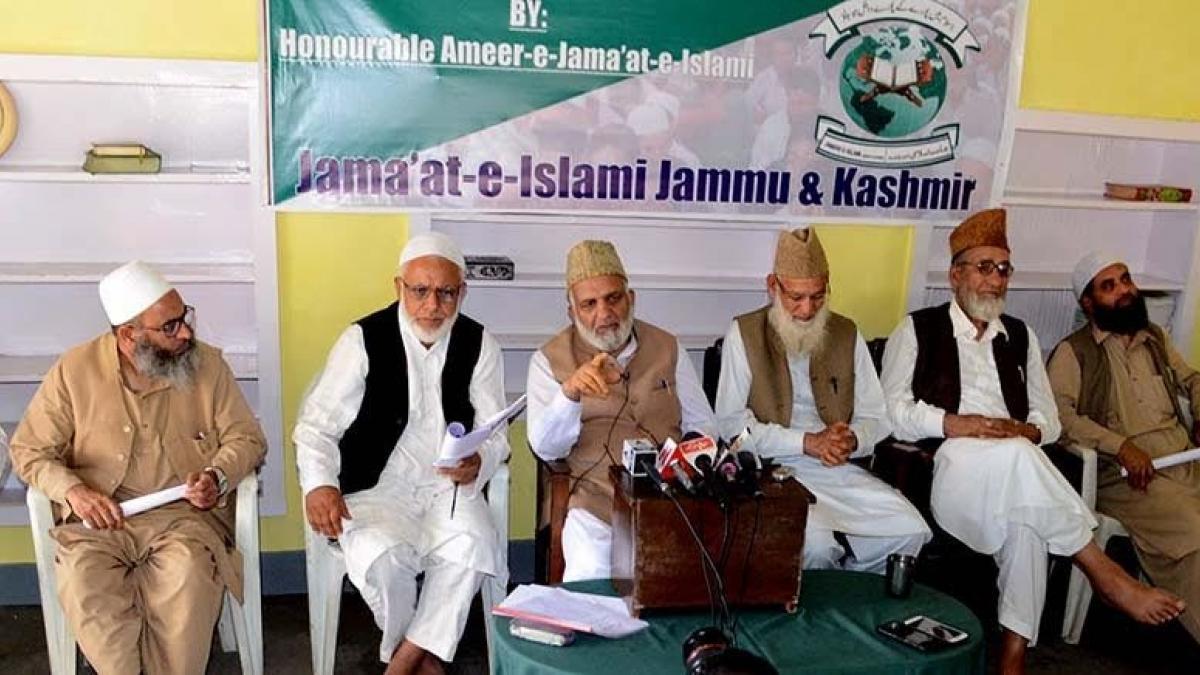
The latest rupture within the banned Jamaat-e-Islami Jammu and Kashmir is being presented, understandably, as a dispute between the organization’s old guard and the group of its former functionaries who moved into electoral politics through the Justice and Development Front. Yet the controversy has a much larger significance. It touches upon an old and recurring feature of Jamaat's political conduct, namely its difficulty in acknowledging, and at times its apparent refusal to preserve, the memory of compromises and political accommodations made in periods of extraordinary adversity.
This is not simply a dispute over properties, political representation or ideological inheritance. It raises a more fundamental question about institutional responsibility. What happens when a politico-religious organization authorizes individuals to negotiate on its behalf during a period of acute political pressure, permits a process of adjustment to develop, and later distances itself from those very individuals when circumstances become less unfavorable?
Jamaat has a history in which institutional memory appears to have been selectively preserved. Individuals who have acted with the authority of the organization at crucial moments have subsequently found themselves politically isolated or disowned when the circumstances that necessitated their intervention have changed.
The question is particularly relevant to the present controversy because Jamaat has a history in which institutional memory appears to have been selectively preserved. Individuals who have acted with the authority of the organization at crucial moments have subsequently found themselves politically isolated or disowned when the circumstances that necessitated their intervention have changed. The present confrontation therefore needs to be examined not as an isolated disagreement, but against this longer history of authorization, accommodation and subsequent denial.
I have argued since the government agencies entered into a discreet dialogue with a Jamaat-authorized panel in 2020 that the episode needed to be understood in precisely this context. My argument at the time was that the organization, confronted with an exceptionally adverse situation, had an obvious incentive to create a channel of communication with the state without necessarily assuming publicly all the political consequences of that engagement. Those entrusted with entering the dialogue could explore compromises, adjustments and possible political openings while the organization retained the option of maintaining ideological distance from the eventual consequences.
The present dispute makes that argument difficult to dismiss.
Recent reporting indicates that the panel involved in discussions with the government subsequently became associated with the creation of the Justice and Development Front. In 2024, Jamaat's Majlis-e-Shura is reported to have adopted decisions providing for constitutional and democratic political activity and the creation of a political front. The document recording those decisions reportedly carried the signatures of senior figures, including former chief Ghulam Mohammad Bhat, who has now publicly distanced the organization from the JDF.
This is where the present controversy becomes more than a factional disagreement.
Bhat has now asserted that Jamaat has no connection with any political party and has questioned the JDF's claim to represent its political legacy. The JDF side, in turn, maintains that its political activity was authorized through Jamaat's institutional process and conducted within constitutional parameters. The disagreement has also extended to Jamaat-linked properties and institutions.
The contradiction is difficult to overlook. If the JDF was merely an unauthorized enterprise undertaken by a handful of individuals, then the organization has to explain why people associated with its own authorized process were able to take that political route. If, on the other hand, the political transition emerged from a process that had institutional sanction, then the subsequent attempt to detach Jamaat from its consequences raises a different and more difficult question: can an organization retrospectively disown a process simply because the political circumstances surrounding it have changed?
This is the central issue that the present controversy brings to the surface.
Jamaat is, of course, entitled to change its political position. No organization is permanently bound to every tactical or strategic decision it has taken in the past. Political circumstances change, leadership changes and organizations reassess their methods. There is nothing inherently improper in such evolution.
What is problematic is the refusal to acknowledge that the evolution occurred.
An organization can revise a decision, but it cannot responsibly erase the historical circumstances in which that decision was taken. It can reject an earlier strategy, but it cannot simultaneously deny that the strategy existed, that it was undertaken by authorized representatives, or that it served a particular institutional purpose at a particular point in time.
This distinction is especially important in the case of Jamaat because its political history contains several episodes of adjustment that have subsequently been remembered selectively. Founded in 1942, Jamaat-e-Islami Jammu and Kashmir has never been an ordinary political party. Its political identity has been deeply intertwined with its religious and ideological framework, and its position on the constitutional and political status of Jammu and Kashmir has historically distinguished it from mainstream political organizations.
Yet that ideological distinctiveness has never prevented tactical engagement with political institutions when circumstances demanded it. Jamaat participated in the 1987 elections as part of the Muslim United Front, despite the considerable distance between its ideological outlook and the conventional framework of electoral politics. The organization subsequently entered a very different political phase, eventually becoming the subject of a government ban in 2019, a prohibition that was extended in 2024.
It was against this background of severe institutional pressure that the developments of 2020 acquired their importance.
The dialogue was not occurring in an ordinary political environment. Jamaat's organizational space had been drastically curtailed, its political activities were under intense scrutiny and the possibility of its conventional return to public political life appeared remote. In such circumstances, opening a channel to the state was not a minor administrative decision. It represented a significant political adjustment.
The people who entered that process therefore mattered.
They were not simply private citizens having conversations of their own. If they were authorized to represent the organization, then their actions and the political space they subsequently created formed part of Jamaat's institutional history. Whether one approves of their decisions or disagrees with them is a separate matter. The historical fact of authorization, if established, cannot be made to disappear merely because the organization’s current leadership finds the consequences inconvenient.
This is where Jamaat's relationship with its own institutional memory becomes particularly interesting. There is a difference between repudiating a past decision and refusing to remember it. The first is a legitimate political act. The second creates a serious problem of institutional accountability.
Jamaat has repeatedly had to negotiate the tension between ideological consistency and political necessity. At crucial moments, necessity has produced adjustments that would have been difficult to imagine under more favourable circumstances. Yet when the pressure has eased, the memory of those adjustments has often become politically inconvenient. The individuals who carried out the difficult work of negotiation can then become expendable, while the organization attempts to restore an image of uninterrupted ideological consistency. That pattern, rather than any individual personality dispute, deserves scrutiny.
The question is not whether Jamaat has changed. It plainly has, at different points and in different ways. The question is whether it has been willing to own those changes as part of its history. The present dispute suggests that the answer may be complicated.
The irony is that political pragmatism is not necessarily a weakness. Indeed, the ability to recognize changed circumstances and adapt can be a sign of political sophistication. The problem arises when pragmatism is considered legitimate only when practiced internally and under pressure, while the same accommodation is condemned when practiced by others.
This brings us to a broader comparison with the Rashtriya Swayamsevak Sangh, although the two organizations belong to very different ideological traditions and should not be treated as equivalent institutions.
The RSS, like Jamaat, has experienced periods of prohibition and severe political adversity. It was banned in 1948, during the Emergency in 1975 and again in 1992 following the demolition of the Babri Masjid. The history of those prohibitions also contains episodes of negotiation, political adjustment and institutional accommodation. The comparison is therefore not one of ideology but of political behavior under pressure.
The broader question is uncomfortable but legitimate. Why do organizations that have themselves demonstrated a capacity for extraordinary accommodation at moments of vulnerability subsequently claim a heightened moral authority from which to judge accommodation by others?
There is a peculiar politics involved here. Compromise becomes necessity when one's own institutional survival is at stake, but betrayal when somebody else makes it. Political adjustment is defended as tactical wisdom when undertaken internally, yet denounced as ideological surrender when undertaken outside the organization.
Neither Jamaat nor the RSS has a monopoly over this contradiction. It is a recurring feature of ideological organizations that seek to combine political effectiveness with claims of moral or doctrinal consistency. But in Jamaat's case, the present dispute makes the contradiction particularly visible because the argument is now taking place between people who were themselves part of the organization’s political evolution. That is why the role of the former negotiators is so important.
If they exceeded their mandate, Jamaat is entitled to say so. If they acted without authority, the organization is entitled to reject their political claims. But if they were authorized representatives who operated within a process known to and sanctioned by the organization, their subsequent repudiation raises a serious question about the nature of institutional responsibility.
Who authorized them? What exactly where they authorized to discuss? What compromises were considered? What political possibilities were explored? Who knew about them? Who approved the subsequent political arrangements? And why are individuals associated with that process now being presented as though they had acted entirely on their own?
These are not questions of factional loyalty. They are questions of political history.
The property dispute surrounding Jamaat and the JDF may eventually be resolved through legal or administrative mechanisms. The deeper dispute cannot be settled so easily because it concerns the ownership of history itself.
The JDF is claiming a particular inheritance from Jamaat's recent political evolution. Jamaat's present leadership is contesting that claim. Beneath the argument over organizational control lies an even more consequential struggle over who gets to define what happened during the years when the organization was under extraordinary pressure.
That struggle is likely to become increasingly important.
Political organizations often maintain two versions of their history. There is the history experienced internally by those who deal with difficult circumstances, and there is the history subsequently presented to the public once those circumstances have passed. The first is usually complicated, untidy and full of compromises. The second tends to be cleaner, more ideological and considerably easier to defend.
The difficulty arises when the people who lived through the first version refuse to accept the second.
This may be what is happening within Jamaat today. The organization’s old guard appears to be asserting continuity with its established ideological position, while the political actors associated with the JDF are pointing towards the process through which they say they were authorized to enter constitutional politics. Both sides are therefore claiming legitimacy from different parts of Jamaat's own history.
But history cannot be selectively summoned. If the organization wishes to invoke its past to establish its moral authority, it must also accept the less convenient chapters of that past. The compromises made under pressure are part of its history just as much as its ideological declarations. The people who negotiated on its behalf are part of that history as well. They cannot be institutional representatives when their work is useful and private dissidents when its consequences become uncomfortable.
This is ultimately the weakness in any attempt to erase institutional memory.
The past does not disappear because an organization changes its interpretation of it. Documents remain, decisions remain, people remember and political consequences survive long after the original circumstances have vanished.
Jamaat's present crisis is therefore not simply about the JDF. It is about whether a politico-religious organization can revise its political course without revising its own history in the process.
There is nothing inherently objectionable in Jamaat choosing a different political path today from the one it contemplated or pursued yesterday. What deserves examination is the attempt to separate today's organization from yesterday's decisions without adequately explaining the transition between the two.
That is the real significance of the current rupture.
It brings back a question that has surfaced repeatedly at crucial junctures of Jamaat's history: when circumstances become exceptionally difficult, how much accommodation is considered permissible, and when circumstances improve, who is left to carry the political responsibility for that accommodation?
The people who enter the room on behalf of an organization cannot simply cease to have represented it when the room becomes politically embarrassing.
Nor can an organization repeatedly demand the right to judge the compromises of others while treating its own compromises as historical episodes that need not be remembered.
The most serious test of moral authority is not ideological rigidity during favorable times. It is intellectual honesty about the compromises made during unfavorable ones. Jamaat is now confronted with that test. The outcome of its dispute with the JDF may determine who controls particular institutions, properties or political platforms. More importantly, however, it may determine whether Jamaat's next chapter is written as a continuation of its history or as another attempt to edit that history after the circumstances that produced it have changed.
Perhaps the clearest way of understanding Jamaat's functioning lies in this very contradiction. Until 1987, contesting elections was not only compatible with its political and religious outlook; it was treated as a legitimate and even necessary political obligation. After 1987, the same electoral process was subjected to an altogether different moral vocabulary, with participation in elections by others at various points being portrayed as un-Islamic and, in its more severe formulations, as tantamount to treason or infidelity. That extraordinary reversal should, in any ordinary political culture, have triggered a serious examination of the organization’s intellectual consistency and political conduct. Yet Jamaat has managed to preserve an extraordinarily durable moral authority in the public imagination despite such contradictions. The reason may lie in something deeper than its organizational strength. Over decades, it has succeeded in establishing a kind of proprietary claim over the language of political Islam in Kashmir, allowing its ideological pronouncements to acquire an authority that frequently places them beyond ordinary political scrutiny. Its compromises are then presented as necessities, its reversals as strategic wisdom, and the inconvenient chapters of its history are gradually pushed beneath the rubble of collective memory. This may ultimately be the most revealing feature of Jamaat's political functioning: not that it has never compromised, reversed course or adapted to circumstances, but that it has repeatedly managed to preserve its claim to moral authority while leaving remarkably little public space for the ordinary Kashmiri to question the contradictions embedded in that history.
Related Articles
Jammu and Kashmir Police: From a Force Under Siege to the Frontline of Counter-Terrorism
Muhammad Zaid Malik (KPS)
The history of the Jammu and Kashmir Police since the outbreak of terrorism is, in many ways, the history of an institution that was forced to reinvent itself while operating under fire. In the late 1980s, the force was essentially a conventional civil police organisation.

Detailed Concept Note
Dr Mehraj Ud Din Shah
Industry 5.0 Adoption: Strategic Transformation and Critical Challenges
The Government Has a Mandate. Does It Have the State to Deliver?
Rukhsana Waheed
For the first time in many years, Jammu and Kashmir has a government that derives its authority from a directly elected Legislative Assembly and is expected to answer, at least politically, to the people who elected it. That change is important.
Srinagar Airport's ₹1,677-Crore Expansion: Building for the Next Decade
Kashmir Central Desk
In an interaction with Insha Sofi for Kashmir Central, the Director of Srinagar International Airport, Mr. Javed Anjum discusses the four-year expansion programme, the new terminal, increased passenger capacity, apron expansion, city connectivity and the challenge of transforming the airport while keeping it fully operational.
Beyond the Pomp: The Logistical Strain of the 3-Tier Local Governance Promise
Bashir Assad
For twenty-eight thousand former Panchayat members across the fractured valleys and rugged highlands of Jammu and Kashmir, democracy has long been an exercise in prolonged anticipation. Following the highly publicized Assembly elections that finally restored a regional legislative assembly, the focus has abruptly shifted from the grand statecraft of the civil secretariat to the unpaved alleys of rural development.
The Protest That Won’t Go Away
Rafi Ahmad Mir
Pakistan-administered Kashmir and the limits of political management