politics
Reimagining Tourism Beyond Gondola
By Waseem Hassan | Mon May 04 2026
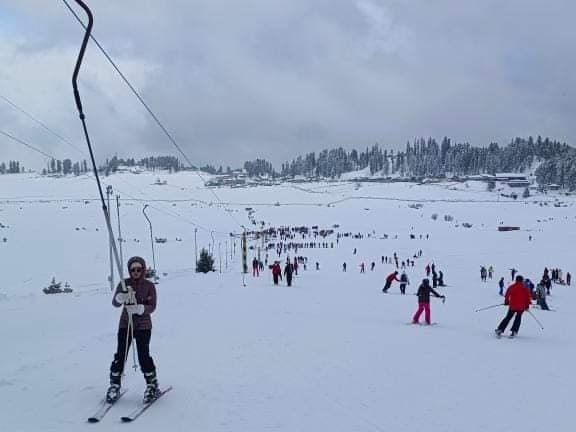
For decades, the idea of tourism in Kashmir has been inseparable from a familiar visual vocabulary. The image of the gondola ride at Gulmarg Gondola, the houseboats resting quietly on Dal Lake and the lush green gardens of Pahalgam have long defined the region’s tourist imagination. These sites, while iconic, represent a particular phase in the evolution of tourism in Kashmir, one that privileged scenic consumption and curated experiences over deeper engagement with the region’s social and ecological realities.
Beyond gondolas and houseboats, a new tourism is emerging in Kashmir. The one that seeks meaning, yet risks repeating old patterns.
In recent years, however, a subtle but significant transformation has begun to take shape. Tourism in Kashmir is gradually moving beyond these established circuits not merely in search of new destinations but in pursuit of a different relationship with place. This emerging trend, which may be described as ultra offbeat tourism, signals a shift from visibility to immersion and from spectacle to experience.
The rise of this form of tourism in Kashmir must be situated within broader global changes in travel behaviour but it also reflects region specific dynamics. The saturation of traditional tourist hubs has altered both the supply and demand sides of the industry. Popular destinations, once associated with serenity and exclusivity now experience seasonal congestion, rising costs and a degree of cultural standardization. For a growing segment of travellers, particularly younger and more globally mobile individuals, this has diminished the experiential value of conventional tourism. In response, there is an increasing inclination to move toward spaces that are less mediated and more intimate.
This outward movement is visible in the growing interest in regions such as Gurez valley, Bangus valley and Lolab valley in frontier districts of North Kashmir’s Kupwara and Bandipora and Doodpathri in Budgam District of Central Kashmir. These landscapes, until recently peripheral to the mainstream tourist map are now being rediscovered as sites of ecological richness and cultural distinctiveness. Yet, what draws travellers to these spaces is not merely their relative obscurity. It is the possibility of encountering Kashmir in a form that is less curated and more lived.
In these emerging circuits, the experience of travel is increasingly shaped by forms of participation rather than observation. Visitors are drawn to homestays that offer insight into local ways of life, to agrarian settings where seasonal rhythms dictate daily activity and to high altitude terrains that demand physical engagement with the landscape. Travel, in this sense, becomes less about covering distance and more about inhabiting a place, however temporarily. It is this shift that distinguishes ultra offbeat tourism from earlier forms of alternative travel.
At the same time, this transformation is not without its complexities. The expansion of tourism into relatively untouched areas introduces new economic possibilities for local communities, many of whom have historically remained at the margins of the region’s tourism economy. Small scale hospitality ventures, local guiding networks and community based initiatives have begun to create alternative livelihood pathways. In regions like Gurez and Lolab, where formal economic opportunities have been limited, tourism offers a means of localized development that is both immediate and tangible.
However, the very processes that enable this expansion also carry inherent risks. The incorporation of offbeat destinations into broader tourism circuits often initiates a cycle of exposure, commodification and eventual saturation. Infrastructure development, while necessary, can strain fragile ecosystems. Cultural practices, once embedded in everyday life, may be repackaged to meet external expectations. The challenge, therefore, lies in ensuring that the movement toward the offbeat destinations does not simply replicate the patterns that have already transformed more established destinations.
There is also a deeper tension that underlies the rise of ultra offbeat tourism in Kashmir. The region occupies a complex political and historical space and any engagement with its landscapes is inevitably mediated by these realities. For some travellers, the appeal of lesser known areas is intertwined with a desire to understand Kashmir beyond its surface representations. Yet this raises questions about the ethics of such engagement. To what extent can tourism meaningfully access lived realities without reducing them to experience? And how can such encounters be structured in ways that respect both the dignity and the autonomy of local communities?
These questions point toward the need for a more reflective approach to tourism, one that recognizes the limits of consumption and the importance of context. Ultra offbeat tourism, if it is to sustain itself as a meaningful alternative, must be anchored in principles of ecological sensitivity, cultural respect and community participation. This requires not only policy interventions but also a shift in the expectations and conduct of travellers themselves.
What is unfolding in Kashmir today is not merely a diversification of tourist destinations but a reconfiguration of the very idea of travel. The movement beyond the gondola is, in essence, a movement away from a fixed and familiar gaze toward a more open and exploratory engagement with place. It reflects a growing recognition that the value of Kashmir does not reside solely in its iconic landscapes but in the multiplicity of experiences that lie beyond them.
Yet, this transition remains fragile. The offbeat, by its very nature, exists in a state of becoming. It derives its meaning from its distance from the mainstream and this distance is continually eroded by the forces of visibility and demand. The future of tourism in Kashmir will therefore depend not on how quickly new destinations are discovered but on how thoughtfully they are engaged.
If Kashmir is to move beyond its established tourist imagination, it must do so with a sense of restraint and awareness. The real promise of ultra offbeat tourism lies not in opening up every untouched landscape but in cultivating a form of travel that allows those landscapes to retain their integrity. In that sense, the question is not simply where tourism goes next but how it chooses to arrive.
Related Articles
Kashmir at crossroads after West Asian conflict
Mareaya Fayaz
The escalating conflict between the United States, Israel and Iran has caused repercussions that extend well beyond the immediate battlefield. While the world’s headlines are dominated by the geopolitical concerns, areas like Jammu and Kashmir are discreetly preparing for economic repercussions.
Vanishing Waters of Kashmir
Yawar Yousef
Jammu and Kashmir has for centuries been known as a land of extraordinary natural beauty, where snow-fed rivers, crystal springs, wetlands and lakes shaped not only the landscape but also the identity of its people. From the celebrated Dal Lake and Wular Lake to the countless lesser known alpine lakes,
How Internal Dissent is Eroding NC’s Credibility?
Mian Tufail
In a functioning democracy, three pillars legitimacy, authority and accountability are expected to operate in synchrony. Legitimacy, derived from the ballot, empowers a government with moral and political authority. Authority, in turn, enables governance.
Islam Beyond Arab Identity and Symbolism
Mohammad Zaid Malik
There are moments in history when a message emerges from a particular land yet refuses to belong to that land alone. Islam was one such message. It rose in the sands of seventh century Arabia but from its very inception, it spoke in a language meant for all of humanity.
TRANSITION FROM SECURITY GRID TO GOVERNANCE GRID
Bashir Assad
For much of the past three decades, the experience of the state in Kashmir has been defined by its visibility in security terms. Checkpoints, patrols and the pervasive architecture of surveillance constituted not merely an administrative arrangement but a lived reality that shaped how governance itself was perceived.
The Protest That Won’t Go Away
Rafi Ahmad Mir
Pakistan-administered Kashmir and the limits of political management