politics
Beyond Surveillance: Reimagining Madrasas and Religious Seminaries in Jammu and Kashmir
By Yawar Yousef | Sun Jun 07 2026
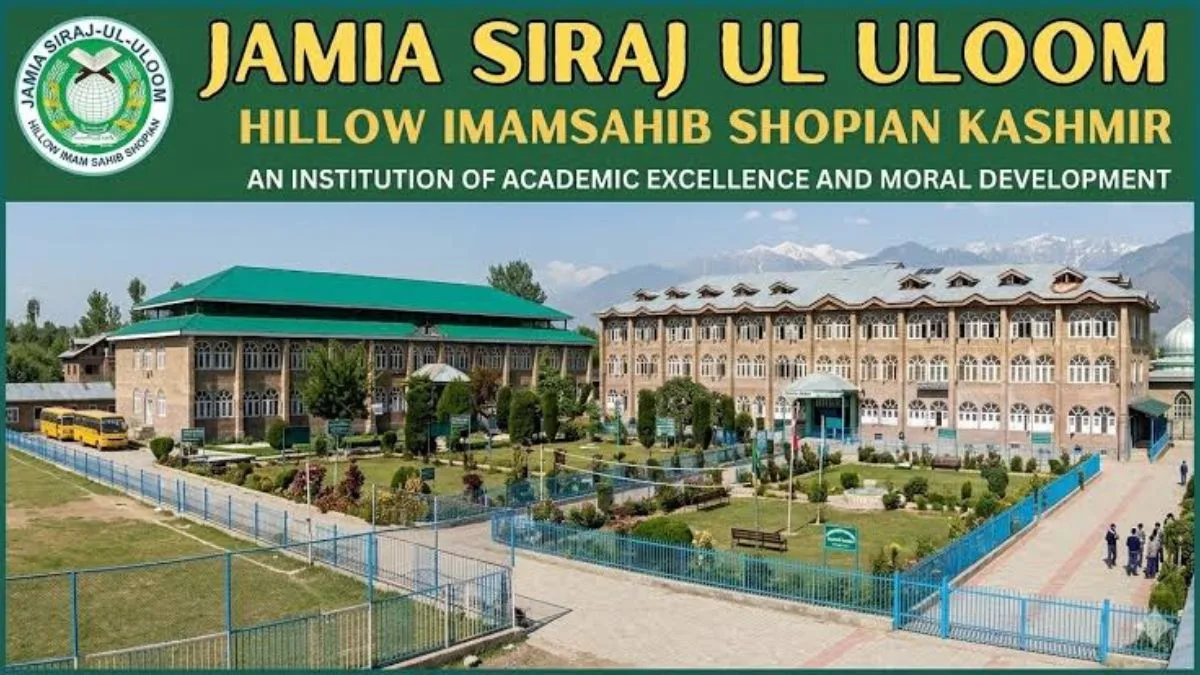
The debate surrounding madrasas and religious seminaries in Jammu and Kashmir has remained trapped within a narrow and repetitive framework for far too long. Public discourse oscillates between suspicion and defensiveness, between securitized scrutiny on one side and emotional religious rhetoric on the other. Governments frequently approach these institutions through the language of surveillance, regulation, and prohibition, while religious organizations portray criticism as hostility toward faith itself. Between these competing narratives, the central issue continues to remain largely unaddressed: the educational, intellectual, and developmental future of thousands of children studying in such institutions.
The discussion becomes even more intellectually impoverished because it is often reduced to simplistic binaries. Either madrasas are presented as sacred educational spaces beyond criticism, or they are viewed entirely through the prism of extremism and radicalization. Both positions obscure deeper structural realities. The real challenge lies neither in the existence of religious education nor in the faith of the students who enter these institutions. The challenge lies in the ideological orientation, educational isolation, and developmental limitations that characterize many such seminaries, particularly when they operate outside broader frameworks of modern intellectual and professional engagement.
The central tragedy of the madrasa debate in Kashmir is that it has remained trapped between securitized suspicion and emotional defensiveness, while the educational future of thousands of poor children continues to remain neglected.
It is important at the outset to distinguish between religion and ideology. Religion, in its civilizational and spiritual sense, concerns ethical conduct, metaphysical inquiry, moral discipline, and the cultivation of inner consciousness. Ideology, however, seeks social reproduction, organizational expansion, intellectual conformity, and influence over public behaviour. Many religious seminaries across South Asia increasingly function not merely as theological institutions but as ideological ecosystems where particular interpretations of religion are reproduced generation after generation. The objective often extends beyond spiritual education toward the preservation and expansion of organizational influence.
This distinction is particularly significant in Jammu and Kashmir, where society has already endured decades of political instability, conflict, social fragmentation, and psychological exhaustion. In such environments, educational institutions assume immense importance because they shape future social consciousness. The question therefore is not whether religious education should exist. Every society has the right to preserve theological traditions and spiritual learning. The question is whether thousands of economically vulnerable children should remain confined within educational systems that often fail to equip them with the intellectual, scientific, technological, linguistic, and professional capacities necessary for meaningful participation in the modern world.
The deeper tragedy is that many of these seminaries possess substantial physical infrastructure, community funding, social legitimacy, and organizational networks that could potentially become transformative educational assets if reimagined properly. Instead of emerging as centres of excellence capable of producing scientists, doctors, researchers, entrepreneurs, diplomats, technologists, civil servants, and scholars of religion grounded equally in modern knowledge, many remain confined within narrow pedagogical structures disconnected from contemporary intellectual realities.
Equally troubling is the absence of a coherent long term state policy regarding these institutions. Governments oscillate between neglect and crackdown. Periodic bans, raids, closures, or regulatory interventions may generate immediate political messaging, but they rarely produce structural transformation. In many cases, prohibitory approaches merely lead to repackaging. Institutions change names, shift locations, alter organizational structures, or continue informally through decentralized networks. The underlying educational vacuum remains intact.
This reveals a larger policy failure. States often approach the madrasa question primarily as a security problem rather than a developmental challenge. Such an approach misunderstands both the sociology of these institutions and the aspirations of the families sending children to them. Most students studying in religious seminaries are not ideological actors. They are products of economic vulnerability, social inequality, and limited access to quality education. Their families frequently choose such institutions not because they reject modernity, but because these seminaries offer food, accommodation, basic education, social dignity, and a sense of structured belonging at minimal cost.
The problem therefore lies less with poor students and more with the intellectual architecture surrounding them. A child entering a madrasa is not born intellectually isolated. Isolation is socially produced through curricular limitations, institutional closure, restricted exposure, and pedagogical systems that prioritize doctrinal reproduction over critical inquiry.
What is needed in Jammu and Kashmir is not merely regulation, nor hostility toward religion, nor symbolic bans designed for political optics. What is needed is a civilizational educational intervention capable of transforming existing religious infrastructure into modern centers of excellence while preserving legitimate theological study within broader frameworks of contemporary learning.
The failure to imagine such a transformation reflects not only administrative weakness but also intellectual laziness. It is far easier for governments to police institutions than to reform them. It is easier to issue closure notices than to create world class educational alternatives. Yet societies are not transformed through prohibition alone. They are transformed through vision.
Ideology, Educational Isolation, and the Production of Intellectual Dependency
One of the most uncomfortable but necessary observations regarding many contemporary religious seminaries is that they often function less as spaces of open intellectual exploration and more as systems of ideological reproduction. This reality is not unique to Kashmir or even South Asia. Across multiple regions of the world, religious organizations frequently establish educational institutions not simply for spiritual instruction but for the preservation of doctrinal authority, organizational continuity, and influence over future generations.
This does not imply that every madrasa promotes extremism or violence. Such generalizations are both intellectually dishonest and socially dangerous. However, it is equally dishonest to pretend that many seminaries operate as neutral educational environments detached from ideological objectives. Educational structures shape worldviews. Curricula influence consciousness. Institutional environments define the limits of acceptable thought. When educational systems remain excessively inward looking and disconnected from broader intellectual traditions, they risk producing intellectual dependency rather than intellectual confidence.
The problem is not the child studying in a seminary, but the intellectual isolation surrounding him. No society can progress by denying its most vulnerable children access to science, technology, professional education, and critical inquiry.
The most serious consequence of such isolation is not necessarily militancy. It is intellectual narrowing. Students educated exclusively within rigid theological frameworks often emerge insufficiently equipped to engage with the complexity of contemporary society. Their exposure to science, philosophy, economics, constitutionalism, technology, literature, comparative religion, political theory, global history, and modern ethics frequently remains minimal. This educational confinement limits not only professional mobility but also cognitive flexibility.
In Kashmir, where generations have already experienced political uncertainty and social disruption, the consequences become even more pronounced. Societies recovering from prolonged instability require educational systems capable of producing adaptive, creative, critically thinking citizens. They require institutions that expand intellectual horizons rather than narrow them further.
Yet many religious organizations continue investing enormous financial and organizational energy into expanding seminary networks instead of building advanced hospitals, research universities, technical institutes, professional academies, innovation centers, or modern schools capable of competing nationally and internationally. This represents not merely a developmental gap but a moral contradiction.
If religious leadership genuinely seeks the welfare of the community, then educational investment should prioritize empowerment rather than dependency. A society cannot achieve dignity merely through the multiplication of preachers. It requires doctors capable of serving public health, engineers capable of building infrastructure, scientists capable of contributing to knowledge production, entrepreneurs capable of generating economic mobility, and intellectuals capable of engaging the modern world with confidence.
The paradox becomes particularly visible when one examines the social composition of many madrasa students. A large proportion belong to economically vulnerable families with limited educational opportunities. Wealthier sections of society rarely send their own children into purely theological educational systems disconnected from professional advancement. Instead, they pursue modern schooling, international education, technical training, and professional careers. Consequently, seminaries frequently become educational spaces inhabited disproportionately by the economically marginalized.
This creates a troubling educational hierarchy within society itself. One class of children receives exposure to technology, languages, science, research, and global opportunity, while another remains confined within narrow pedagogical structures that offer limited pathways into the contemporary economy. The result is not merely educational inequality but the reproduction of social dependency across generations.
Such conditions also create fertile ground for ideological influence because intellectual isolation often increases institutional dependency. Students whose entire socialization occurs within closed theological systems may struggle to independently interrogate authority structures or critically examine inherited assumptions. The issue here is not faith itself. Faith and intellectual openness are not mutually exclusive. Some of the greatest scholars in human history combined spirituality with scientific and philosophical sophistication. The problem emerges when educational systems discourage curiosity, complexity, and independent inquiry.
The tragedy is that this intellectual confinement frequently occurs despite the remarkable cognitive potential of the students themselves. Many madrasa students display extraordinary memory, discipline, linguistic ability, and commitment to study. With access to quality modern education, scientific training, digital literacy, and critical pedagogy, many could excel in fields far beyond narrow theological specialization.
This is precisely why the current debate requires reframing. The issue should not be approached through the emotionally charged language of religion versus secularism. Rather, it should be understood as a question of educational justice and national development. Are poor children entitled to the same quality of education, scientific exposure, professional opportunity, and intellectual mobility available to more privileged sections of society? Or should they remain confined within systems that reproduce limited futures?
The answer to this question will shape not only the future of Jammu and Kashmir but the future relationship between religion, modernity, and social progress across South Asia more broadly.
The Failure of State Policy
The governmental response toward madrasas and seminaries in Jammu and Kashmir has largely remained reactive rather than visionary. Policies emerge primarily during moments of security concern, political controversy, or administrative pressure. The result is an approach dominated by surveillance, registration drives, periodic crackdowns, financial scrutiny, and occasional bans. While states possess legitimate authority to regulate educational institutions operating within their jurisdictions, regulation without transformation rarely produces meaningful outcomes.
The fundamental weakness of current policy lies in its inability to distinguish between institutions, actors, and objectives. Governments frequently approach seminaries through broad securitized frameworks that fail to address underlying educational realities. Closure of institutions may temporarily disrupt organizational networks, but it does not resolve the structural conditions that allowed such networks to emerge in the first place.
Indeed, history repeatedly demonstrates that purely prohibitory approaches often produce institutional adaptation rather than disappearance. Organizations change names, relocate operations, fragment into smaller informal units, or continue functioning through decentralized social networks. Ideological ecosystems rarely disappear through administrative notification alone. When demand for religious education persists and state educational alternatives remain weak, closure strategies often generate repackaging rather than reform.
This is where the absence of long-term strategic thinking becomes evident. Instead of asking how these institutions can be transformed into engines of educational excellence, policy discourse remains trapped within the narrower logic of control and containment.
Bans and crackdowns merely produce institutional repackaging. The real challenge before the state is whether it possesses the vision to transform religious seminaries into centers of educational excellence capable of producing scientists, scholars, innovators, and enlightened citizens.
The irony is that many seminaries already possess precisely the infrastructural foundations that governments struggle to create elsewhere. They have buildings, land, classrooms, hostels, kitchens, community support, donor networks, and established local legitimacy. Rather than viewing these spaces solely as sites of suspicion, the state could have approached them as potential educational assets capable of being integrated into a broader developmental framework.
Imagine if the policy objective had been transformation instead of confrontation. Imagine if the government had initiated a phased program through which madrasa infrastructure was gradually integrated into modern educational ecosystems while preserving optional theological study within balanced curricula. Imagine if every district identified one or two major seminaries for conversion into high quality educational campuses equipped with science laboratories, digital classrooms, libraries, sports facilities, language centres, and professional training programs.
Such a project would require political courage, administrative sophistication, and intellectual clarity. But it would produce far more sustainable outcomes than recurring cycles of suspicion and closure.
The core problem is not the existence of poor children studying in seminaries. The problem lies in the educational environment surrounding them. If a student currently memorizing theological texts in an isolated institution were provided access to mathematics, computer science, medicine, law, engineering, literature, philosophy, economics, constitutional studies, and global languages within the same educational ecosystem, the trajectory of that child’s life could change dramatically. This is why the focus should shift from punitive institutional management toward developmental educational transformation.
The state must also recognize an uncomfortable sociological reality. Many families sending children to seminaries do so because state educational systems themselves often remain inadequate. In economically weaker areas, religious institutions sometimes provide food, accommodation, discipline, and educational continuity where public systems fail to inspire confidence. Unless governments create credible alternatives, criticism alone will not change parental choices. A genuinely forward-looking policy would therefore operate across multiple levels simultaneously.
First, theological institutions should be brought under transparent educational regulation ensuring curricular modernization, financial accountability, and minimum academic standards.
Second, students currently enrolled in seminaries should be systematically integrated into mainstream educational pathways through bridge programs, language training, science education, digital literacy, and professional counselling.
Third, state and private partnerships should be established to convert selected seminary infrastructure into hybrid educational campuses capable of offering world class modern education.
Fourth, teacher quality must become central. Educational transformation is impossible if ideological rigidity continues dominating pedagogy. The issue ultimately lies less with children and more with those shaping intellectual environments around them.
This distinction is morally essential. The poor child studying in a madrasa is not the enemy of society. He is often one of its most neglected products. Punishing him for structural failures beyond his control would represent profound injustice. The real challenge lies in transforming the institutional culture surrounding him.
Unfortunately, current state approaches often prioritize immediate political optics over long term social investment. Crackdowns generate headlines. Transformation requires patience. Surveillance produces visible administrative activity. Educational reform demands sustained commitment across decades.
Yet societies are ultimately shaped not by symbolic state power alone but by the quality of educational imagination guiding future generations.
From Seminaries to Centre’s of Excellence
The most constructive approach to the madrasa question in Jammu and Kashmir lies neither in romanticizing existing structures nor in pursuing endless cycles of prohibition. The real challenge is transformational: how can existing institutional infrastructure be repurposed toward educational excellence capable of serving both social stability and human development? This requires a complete shift in conceptual thinking.
Instead of viewing seminaries exclusively through the language of suspicion, the state should recognize that many already possess valuable assets including land, buildings, organizational structures, donor networks, and community legitimacy. These assets should not remain confined within intellectually narrow systems when they could become foundations for world class educational institutions.
A serious reform model would begin by identifying major seminary campuses across districts and gradually integrating them into comprehensive educational redevelopment programs. The objective would not be to eradicate religious study altogether. Societies have every right to preserve theological traditions. The objective would be to ensure that religious education exists alongside modern scientific, technological, linguistic, and professional learning rather than replacing it. Such transformation requires ambitious partnerships.
The government could invite nationally reputed educational chains, universities, healthcare institutions, technological academies, and philanthropic organizations to adopt selected campuses under carefully regulated frameworks. India possesses numerous educational institutions with global reputations in science, medicine, management, engineering, and liberal arts. Why should students emerging from marginalized religious backgrounds remain excluded from such standards of excellence?
Corporate philanthropy and billionaire driven educational investment could also play a transformative role. India’s wealthiest industrial and philanthropic families routinely invest in universities, hospitals, and educational foundations across the country. A visionary national project could encourage leading industrial groups and philanthropic trusts to take responsibility for establishing one major center of excellence in each district of Jammu and Kashmir.
The symbolism of such an initiative would itself be extraordinary.
Imagine a former seminary transformed into a state of the art educational campus equipped with advanced laboratories, modern libraries, digital infrastructure, language institutes, vocational training centers, sports academies, and professional mentoring systems. Imagine children previously limited to narrow theological instruction now studying artificial intelligence, medicine, robotics, biotechnology, constitutional law, environmental science, literature, entrepreneurship, and international relations.
Such transformation would not merely change institutions. It would alter the psychological horizons of an entire generation.
Importantly, the objective should not be cultural humiliation or forced deracination. Educational modernization succeeds only when accompanied by dignity. Students should not be made to feel that their religious backgrounds represent shame. Rather, they should be empowered to see faith and modern intellectual excellence as compatible dimensions of human development.
The historical Islamic intellectual tradition itself offers abundant examples of synthesis between spirituality and scientific inquiry. Medieval Muslim civilizations produced mathematicians, astronomers, physicians, philosophers, geographers, architects, and scholars who engaged the world with intellectual openness rather than pedagogical isolation. Contemporary seminaries frequently invoke historical Islamic greatness while remaining disconnected from the scientific and philosophical spirit that once animated those civilizations.
A genuine educational renaissance in Kashmir would therefore involve reclaiming intellectual curiosity rather than merely preserving doctrinal repetition.
This transformation also requires curricular courage. Students must be exposed to comparative thought, constitutional values, scientific reasoning, ethics, gender studies, environmental awareness, economics, digital literacy, philosophy, psychology, and global history. Education should expand cognitive possibility rather than narrow it.
Teacher reform is equally critical. Institutions cannot become canters of excellence while remaining intellectually captive to rigid pedagogical cultures. Faculty recruitment should prioritize competence, openness, and interdisciplinary engagement. Professional educators, scientists, researchers, psychologists, language experts, and social scientists must become integral components of educational transformation.
Scholarship programs would further accelerate integration. Students emerging from redeveloped seminaries should receive pathways into leading universities across India and abroad. International educational partnerships could expose them to global academic standards while preserving rootedness within local society. The long term societal impact of such a strategy could be profound.
First, it would reduce educational segregation by integrating marginalized students into mainstream intellectual life.
Second, it would weaken ideological dependency by expanding exposure to multiple forms of knowledge.
Third, it would generate social mobility among economically weaker communities.
Fourth, it would strengthen national integration through opportunity rather than coercion.
Fifth, it would demonstrate that the state possesses confidence not merely to regulate institutions but to transform futures.
Most importantly, it would shift the moral centre of the debate.
The current discourse often treats madrasa students either as security concerns or passive recipients of charity. Both perspectives diminish human potential. The real challenge is to view these children as future scientists, scholars, administrators, innovators, physicians, writers, and leaders capable of contributing meaningfully to society if provided the right educational ecosystem.
No civilization advances by abandoning its vulnerable populations to intellectually restricted futures. Societies progress when they expand opportunity, cultivate excellence, and democratize access to high quality education.
Jammu and Kashmir stands today at an important historical crossroads. It can continue oscillating between surveillance and symbolic bans while generations remain educationally marginalized. Or it can pursue a far more ambitious path rooted in transformation, dignity, and intellectual empowerment.
The choice ultimately reflects the larger question confronting the region itself: whether governance will remain reactive and securitized, or whether it can evolve into a genuinely civilizational project centered on human development.
The future of these children should not be confined to inherited ideological structures or endless political anxieties. They deserve laboratories instead of intellectual isolation, libraries instead of doctrinal confinement, and opportunities equal to any child studying in the finest institutions of the country.
The measure of a society is not how loudly it debates its problems, but how courageously it imagines solutions.
If Jammu and Kashmir truly seeks long term stability, social confidence, and intellectual renewal, then educational transformation must become central to that vision. Not because religion must disappear, but because no child should be denied the possibility of excellence in the name of preserving institutional stagnation.
The challenge is therefore not merely to regulate seminaries. It is to transform them from spaces of limited futures into institutions capable of producing enlightened citizens prepared for the complexities of the modern world.
Only then can education become not an instrument of confinement, but a bridge toward dignity, confidence, and collective progress.
Related Articles
The New Economy of Despair Drugs, Easy Money, and The Fragmentation of Kashmiri Youth
Sohail Bhat
The contemporary Kashmiri social landscape is increasingly being shaped by two parallel and deeply contradictory realities. On one side stands a visibly aspirational generation attempting to reposition itself through education, entrepreneurship, digital culture, tourism, technology, competitive examinations, and new forms of professional mobility....
Kashmir tourism and the Architecture of Reassurance
Bashir Assad
Every summer, Kashmir begins preparing itself for observation. Roads are repaired with unusual urgency, flowerbeds appear along major boulevards, security visibility becomes more calibrated, and tourism statistics start acquiring political significance beyond economics. Hotels reopen after long winters, houseboats are repainted, taxi operators negotiate seasonal expectations, and social media fills with carefully framed images of lakes, mountains, tulip gardens, saffron fields, cafés, and snow-covered meadows.
Managing Instability in the Modern Middle East
Mohammad Zaid Malik
The contemporary Middle East is no longer merely a region experiencing recurring crises. It is increasingly becoming a geopolitical system in which instability itself has acquired structural permanence.
The Protest That Won’t Go Away
Rafi Ahmad Mir
Pakistan-administered Kashmir and the limits of political management
WHO OWNS KASHMIR’S WATER?
Sohail Bhat
The rivers of Kashmir have always been more than scenery. They have carried people, shaped settlements, fed fields, powered machines and remained at the centre of one of South Asia’s enduring conflicts. As the old arrangements around water enter uncertain territory, a more immediate question is emerging inside Kashmir itself: who benefits from the water that flows through it?

Economics of Inflation Crusade
Dr Mehraj Ud Din Shah
Inflation is swiftly unfolding macroeconomic fallout across the various sectors, wiping out income, savings, investment, demand, and employment, thereby giving a rude shock to the countries. The existing Inflationary phenomenon is intensively destabilizing the budget plans and regular consumption patterns of the majority of consumers across the globe, including in India.