security
NARCO-TERRORISM AS HYBRID WARFARE AND THE CENTRALITY OF J&K POLICE
By Mohammad Zaid Malik | Tue Mar 17 2026
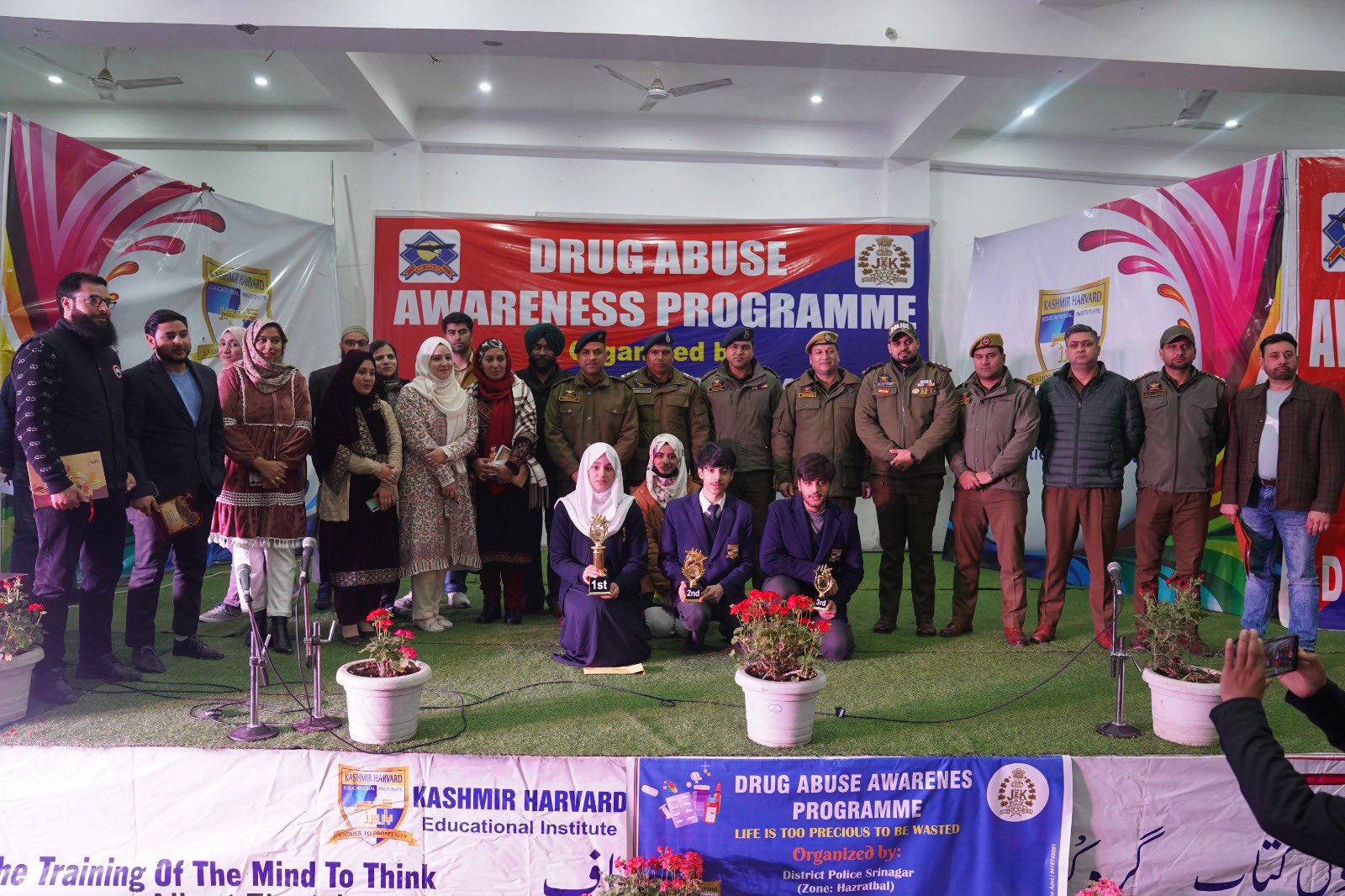
Hybrid warfare does not announce itself with tanks or troop movements. It advances silently, exploiting social fractures, psychological vulnerabilities and illicit economies. In Kashmir, narcotics have become one of the most effective non-kinetic weapons deployed against internal stability. The response to this threat has not been led from distant command rooms or border posts but from within society itself. At the heart of this internal security battle stands the Jammu and Kashmir Police, functioning not merely as a law and order force but as the principal counter hybrid instrument of the Indian state in the valley.
The weaponisation of drugs in Kashmir mirrors classic hybrid warfare doctrine. Since the early 1990s, alongside armed militancy, narcotics entered the region through cross border routes. What appeared as criminal activity was, in effect, a strategic design. Drug trafficking generated terror financing, debilitated youth, fuelled criminality and created societal fatigue without provoking overt military retaliation. This convergence of crime, terrorism and psychological degradation represents a deliberate shift from visible violence to sustained internal erosion.
It is within this grey zone that the Jammu and Kashmir Police have assumed decisive importance. Unlike conventional forces, the police operate continuously among the population, possessing granular human intelligence, legal authority and operational permanence. In a hybrid conflict where threats are embedded within civilian spaces, JKP is not a supporting arm, it is the frontline force.
From rising heroin seizures to preventive detentions and community-based rehabilitation, the fight against narco-terrorism in Kashmir reveals policing as a form of counter-hybrid warfare. This analysis situates the Jammu and Kashmir Police at the heart of a complex battle where crime, addiction and terrorism converge, highlighting their expanding role as both security actors and social stabilisers.
The scale of narcotics enforcement in Jammu and Kashmir over recent years underscores this reality. NDPS cases have risen steadily from 1,173 in 2019 to 1,978 in 2023, with over 9,000 cases registered since 2019. These figures do not indicate policy failure; they reflect enhanced detection, intelligence penetration and sustained pressure on drug networks. The dramatic increase in heroin seizures, nearly 2000 percent between 2017 and 2022, further demonstrates the effectiveness of police-led interdiction.
More significantly, the Jammu and Kashmir Police have disrupted narco-terror networks at their most vulnerable nodes. Through preventive detentions, habitual traffickers and facilitators have been neutralized before they could regenerate supply chains. In 2024 alone, up to March, over 1,500 NDPS cases resulted in more than 2,200 arrests and 274 preventive detentions. This is not routine policing; it is pre-emptive internal security action consistent with counter-hybrid warfare principles.
Hybrid warfare targets demographics and in Kashmir the youth are the primary objective. With a majority of drug users falling between 17 and 33 years of age, addiction threatens not only public health but future economic productivity, social leadership and security manpower. The Jammu and Kashmir Police has recognized this dimension and acted beyond enforcement. By facilitating de-addiction referrals, supporting rehabilitation frameworks under the Nasha Mukht Bharat Abhiyan and engaging communities directly, the police have positioned rehabilitation as a form of counter-terrorism. In 2023-24 alone, over 31,000 individuals received de-addiction treatment, with police playing a pivotal enabling role.
The convergence of drug abuse, crime and terror logistics presents a uniquely dangerous hybrid threat. Heroin dependency, costing up to Rs, 88,000 per month per user, pushes addicts toward theft, smuggling and courier roles. Left unchecked, this creates a pipeline from addiction to organised crime and ultimately to terror facilitation. The Jammu and Kashmir Police have effectively policed this grey zone, disrupting criminal drift before it matures into insurgent support. This early intervention function is one of the least visible yet most critical contributions of policing in hybrid conflict environments.
The challenge is compounded by the adaptive nature of narco-networks. Trafficking has become more decentralised, technologically enabled and financially layered. The involvement of individuals with social influence or access to resources adds further complexity. Yet, the willingness of the Jammu and Kashmir Police to act against facilitators irrespective of status has reinforced deterrence and institutional credibility. In hybrid warfare, credibility and persistence are force multipliers and JKP has demonstrated both.
The fight against narco-terrorism in Kashmir cannot be separated from the broader counter-insurgency framework. Drugs are not a side issue; they are a strategic weapon aimed at exhausting society quietly. The Jammu and Kashmir Police stands as the primary custodian of the internal front, defending communities, preserving youth potential and choking the financial arteries of terrorism.
As the nature of conflict continues to evolve, Kashmir offers a clear lesson: hybrid wars are ultimately won or lost inside society. In that decisive space, the Jammu and Kashmir Police have emerged not just as an enforcer of law but as a stabilising force, a security institution and a shield against silent warfare. The battle against narcotics is therefore not merely a social campaign, it is a national security imperative and the J&K Police is at its center.
Related Articles
As the tide shifts…
Dr. Mareaya Fayaz
JAMMU & KASHMIR. Here, a complex tapestry of political, social, and historical threads, weaves the narrative of a place long marred by conflict. The recent years, however, have witnessed a subtle but significant transformation in the security environment, offering a glimmer of hope for peace, progress and a renewed sense of ambition in the valley.

BRINGING KASHMIR’S BORDER AREAS ONTO THE TOURISM MAP
Dr. Mareaya Fayaz
For decades, Kashmir’s tourism narrative revolved around its iconic destinations like, Gulmarg’s snowy slopes, Pahalgam’s pastoral charm and Srinagar’s shimmering Dal Lake. Yet beyond these celebrated landscapes lies another Kashmir, tucked along the Line of Control where valleys unfold in silence, rivers cut through rugged terrain and villages stand as living testimonies of resilience.
SNOWLESS WINTERS, SCORCHED ORCHARDS
Mian Tufail
In Kashmir, winter has always been more than a season. It is the valley’s silent architect, shaping rivers, nourishing springs and preparing orchards for the bloom of spring. Snow resting on the Pir Panjal and the higher Himalayas has traditionally functioned as a natural reservoir, melting slowly to sustain agriculture and drinking water systems through summer.

WHY EDUCATED KASHMIRI YOUTH ARE CHOOSING TO COME BACK?
Sohail Ahmad
On a pale winter morning, as mist rises gently above the waters of the Dal Lake and shopkeepers lift their shutters in civil lines area in Srinagar, 29-year-old Aamir opens his laptop in a quiet cafe overlooking the boulevard. His screen flickers to life with dashboards, data streams and code repositories connected to a fintech firm headquartered in Pune.
PAKISTAN’S VANISHING DEMOCRATIC SPACE ECHOES OF ZIA IN ASIM MUNIR’S ERA
Bashir Assad
Watching General Asim Munir steadily undermine Pakistan’s political system, consistently shrinking the space for elected leadership and leaving almost no room for civilian voices in domestic governance or diplomatic decision-making, I chose to write on the legacy of General Zia-ul-Haq.